CENTRE RESOURCES

SEAMEO STEM-ED develops and shares high-quality learning resources to support teachers, learners, and education partners across the region. These materials are designed to strengthen teaching practice, encourage innovation in STEM education, and extend the reach of our programmes beyond individual activities. By making knowledge openly available, we help ensure that project outcomes remain useful, adaptable, and sustainable over time.

Filter by

Search

Sort by

Key topic

Resource – Key Topic

type

Resource – Type

TARGET AUDIENCE

Resource – Target
Show More

Partner Resources

Our partner resources reflect the value of collaboration in building lasting educational impact. Through shared tools, publications, and practical materials, we support wider adoption of effective approaches and encourage partners to adapt them within their own contexts. This spirit of knowledge sharing helps strengthen continuity across projects while reinforcing our commitment to quality learning resources as part of the fourth pillar of SEAMEO STEM-ED.

Search

Programme Banners (24)
Condord Consortium Learning Resources
LEARN.CONCORD.ORG provides free, research-based STEM resources that support data literacy, scientific reasoning, and 3D learning from a young age. Aligned with the PISA framework and NGSS, the resources engage learners in using evidence to develop Claims, Evidence, and Reasoning (CER), while integrating disciplinary core ideas, science and engineering practices, and crosscutting concepts to build deeper scientific understanding.
VIEW DETAILS
Programme Banners (22)
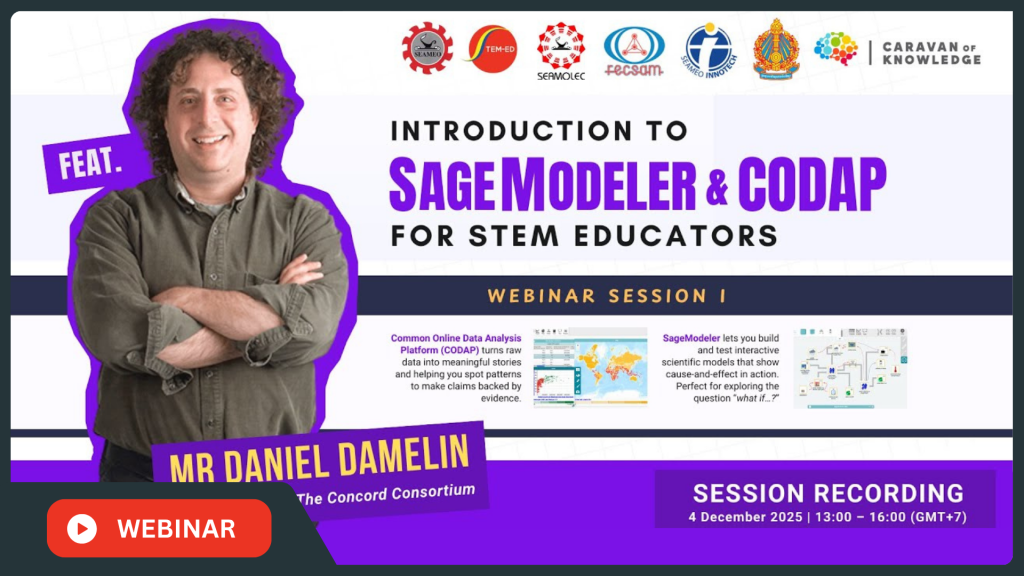
Common Online Data Analysis Platform (CODAP)
CODAP is embedded into STEM-ED's programmes to develop data literacy for learners from a young age, enabling students to explore, visualise, and make sense of real-world data. Through a Claim–Evidence–Reasoning (CER) approach, students use data as evidence to support their claims, explain their reasoning, and communicate evidence-based conclusions.
VIEW DETAILS
Programme Banners (23)
SageModeler
SageModeler is embedded into STEM-ED's programmes to develop scientific reasoning and systems modelling skills from a young age, enabling students to represent, explore, and explain complex real-world phenomena. Through iterative modelling, students use evidence to build, test, and refine models, strengthening their ability to reason about relationships, make predictions, and communicate scientific explanations.
VIEW DETAILS
Filter by

Sort by

Key topic

Resource – Key Topic

type

Resource – Type

TARGET AUDIENCE

Resource – Target
Show More